Category Archives: Third Party Eligibility

Follow up is Key to Effective Medicaid Reimbursements

For best results and timely reimbursements, follow-up needs to be rigorous and consistent. RCA has heard from multiple clients that their eligibility vendors failed to stay on top of accounts and the money eventually ran away from them. Noncompliance and difficult patients are pain points that are made easier through constant contact and account monitoring.

From the minute your uninsured patient leaves the hospital, the clock begins ticking and that revenue becomes harder to recover. In many cases, patients are hard to reach by phone, do not respond to mail correspondence and even the most thoroughly trained staff will struggle with gathering the much needed documentation for maximum reimbursement.

We’ve found that weekly communication to the case worker, agencies and the patient is critical to shortening the amount of A/R days to payment. In search of discharged patients, sometimes this consists of measures including home, jail and shelter visits, transportation to and from appointments, translations services and skip traces.

Bethany Bailey
Regional Vice President
RCAeligibility@resource-corp.com

Are retro Medicaid authorizations bogging down your A/R?

While healthcare providers would prefer that they not be required to obtain retro authorizations, there will inevitably be circumstances that require the dreaded busy work.  However, state Medicaid programs may be slowing down the rate at which services rendered are approved and reimbursed by the program. We have seen an increasing number of retro authorization denials annually across the country, which in many cases result in increased workloads for case management. The work has become so cumbersome that appeal deadlines are often missed, resulting in revenue being left on the table.

In many facilities across the country, case management departments have been charged with ownership of this part of the Medicaid process, which has proven difficult to oversee. An even bigger risk is involved when this work is passed off to the Business Office staff who don’t typically possess the clinical expertise required to be successful in obtaining retro authorizations.

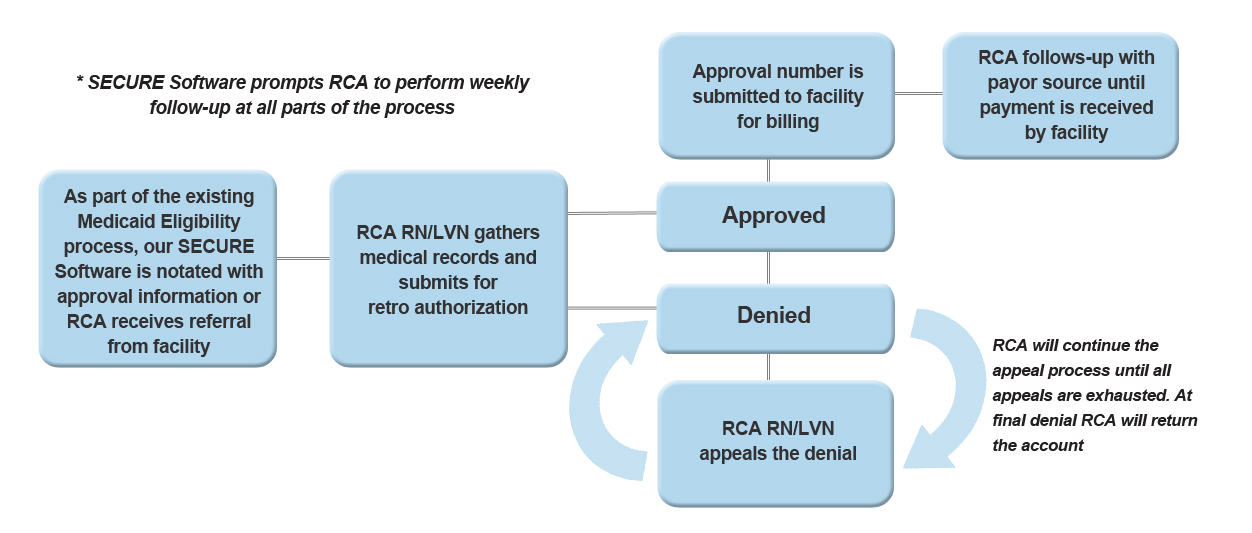
Since RCA provides services as an extension of the hospital’s Patient Financial Services department, we have been asked on several occasions to assist with obtaining retro authorizations after we have successfully secured Medicaid coverage for our patients.  The overall process from facility to vendor doesn’t change and the retro authorization and appeal process fits seamlessly into the daily work queues in which we already oversee.  Immediately following receipt of the retro Medicaid approval, our expert staff begins the authorization process, shaving off precious A/R days by eliminating any unnecessary hand-offs in the process.  In the case of an unfortunate denial, RCA’s clinical staff will make every appeal attempt, and once an authorization number has been approved, it will be submitted to the facility so the account can be billed. Afterwards, RCA will perform routine follow-up to ensure the facility receives payment.

retroauth flow

Don’t let retro authorizations and the appeal process put your self-pay reimbursements or A/R days in jeopardy.  This piece of the Medicaid process can be easily handled through your facility’s existing eligibility process.

bethany


Bethany Bailey
Vice President of Operations and Eligibility Expert
Resource Corporation of America


Coordinating your methods of COB

coordination-clipart-writing-to-win-coordination-in-successful-teamwork-boss-blog-284x284_f142d7

Professionals in the Healthcare and Hospital Revenue Cycle industry have seen an increase in denials due to Coordination of Benefits, especially
when it comes to patient coverage (i.e. insurance coverage, federally funded programs and other benefits.) To begin combating the complexity of it all, your facility has probably already tried to implement a process for COB’s. COB is relatively self-explanatory in its definition; however, effectively performing the function has proven to be quite a bit more involved when the patient doesn’t comply with what is needed from them.

When payment is denied by the payor, because there is belief of existing or additional coverage, that account can quickly become a self-pay account if the appropriate forms are not successfully completed. As a self-pay eligibility vendor, RCA has a vested interest in helping our clients recover those dollars. RCA already performs rigorous account follow-up and has existing resources that are complimentary to an effective COB solution.

Worked much like a self-pay referral, the COB account will require completion of a necessary form (which can be found online), additional information to process the claim
and then actively pursued until resolution. COB services include identifying an accurate payer, initiating billing and securing payment. Additionally, our representatives will coordinate phone calls between the patient and insurance company and will conduct home visits to ensure that the information that is needed to pay the claim is collected and sent to the insurance company. After the information has been submitted, we continue follow up with the insurance company until payment, to ensure that the insurance company does not need any additional information from the patient.

Coordination of Benefits has become increasingly popular with insurance and software companies and their methods are only moderately effective; however, if an account is non-compliant for more than 30 days, you may want to consider “Coordinating another COB Vendor”, who will be more rigorous in the account followup.

bethany

Bethany Bailey
Vice President and Eligibility Expert

Has your facility discovered Pre-Admit Screening services yet?

health-care-money-costsQualifying self-pay patients before they become self-pay patients 

When RCA rolled out our Pre-admit screening services (years ago) we knew we were headed in a direction that no other third-party eligibility vendor had gone before.  Our clients were very excited about this new service and the overall response from the industry was positive.  Pre-admit screenings helped drive insured patients to the hospital who would have otherwise been self-pay.  Surprisingly, this service is still just as cutting edge as it was 10 years ago and we often find ourselves introducing the service during meetings with hospital management.

The process is simple and easily integrated into existing or new eligibility operations.  Our representatives receive referrals from clinics, hospital staff, financial counselors and other community sources prior to a patient’s scheduled service/appointment at the hospital.  RCA then conducts the eligibility screening, gathers the necessary documents and assists with the application process to help enroll the patient with Medicaid.  Procedures that are related to surgery, pregnancy, cancer or any other condition that would eventually lead them to your facility can be leveraged to begin qualifying the patient for financial assistance before it impacts hospital resources and A/R.

If you find yourself like many other facilities, and are seeing an increase in self pay volumes, it may help to consider the lasting benefits the Pre-Admit service can offer the hospital, the physicians and the patients. A successful Pre-admit program will result in quicker certifications & reimbursements, more billable visits and increased coverage on previous medical bills. Feedback from doctors and patients have been favorable toward the pre-admit screening, praising the improved communications and helping to build relationships and loyalty to the hospital.

Third Party Medicaid Eligibility Company Reveals Newly Expanded Office at Ribbon Cutting

HOUSTON, Jan. 31, 2017 /PRNewswire/ — Third Party Medicaid Eligibility company, Resource Corporation of America (RCA), hosted a Ribbon Cutting Ceremony on Friday to celebrate the grand opening of its new support center and regional office expansion.  One of several regional offices in the country, the RCA Houston office is the largest and is located just minutes from the Texas Medical center, the largest medical complex in the world.

The expansion project began less than a year ago, after the company experienced significant growth from new contracts.  In 2016, RCA hired over 120 employees and the Houston regional office more than quadrupled in size.  Additionally, RCA was recognized and listed on the Houston Chronicle’s Top Workplaces survey.

After 23 years of being an industry leader, the privately owned company decided to skip the “growing pains” and made the decision to build out their office knowing it would benefit all parties.  “The need to expand our office was an easy decision and the project began without hesitation,” said Frank Dominguez, Chief Operating Officer for RCA, “RCA’s hospital partners rely on us to provide a high quality service and to be a resource for their facility and their patients.  The additional highly trained staff and larger departments ensure our hospital clients receive the maximum amount of reimbursements.”

The ceremony was attended by employees and partners from both ends of the country and was followed by an open house for clients to tour the building and meet key department managers.

Is it time to hand off Workers’ Compensation claims?

shutterstock_133357538Every provider across the country knows the time consuming pain that is dealing with Workers’ Compensation claims. Here are the top 3 issues we hear providers say they are having with Workers’ Compensation claims:

Low volume of accounts requiring large knowledge base. Workers’ Comp only accounts for roughly 5% of a provider’s accounts receivable, but since every state has their own set of guidelines, this requires highly trained personnel to handle the claims.

Too much paperwork. Workers’ Comp claims processing is still largely a paper-based process. The provider’s personnel must print out the claim documents and assemble the claim by hand and then package it for mailing. This process consumes a great deal of time.

Follow up is crucial. Without constant follow up to the Workers’ Compensation agencies to ensure they have received the provider’s claims, and that the claims are processed and paid correctly, the provider could lose out big time. This part of the process is another cumbersome step.

These are just a few of the reasons more and more providers are looking for outside help in dealing with their Workers’ Compensation claims.

Neil Boudreaux
Eligibility Expert and Director of Operations

Shouldn’t you have more pending in SSI/SSDI?

One aspect of third-party eligibility that is likely not getting enough attention from your vendor or in-house team is SSI/SSDI reimbursements. This is where we see significantly more at-risk dollars and, when followed through properly, makes up the bulk of conversions recovered for our hospital clients. Based on data we collected firsthand, while SSI/SSDI makes up only about 20-40% of self-pay inventory it averages a whopping 60%-80% of pending dollars, on average. Note that while Medicaid accounts are expected to decrease in expansion states, SSI/SSDI is still an important piece of the overall puzzle, no matter expansion or non expansion. We use those averages as a starting point when we are asked to conduct eligibility performance evaluations.
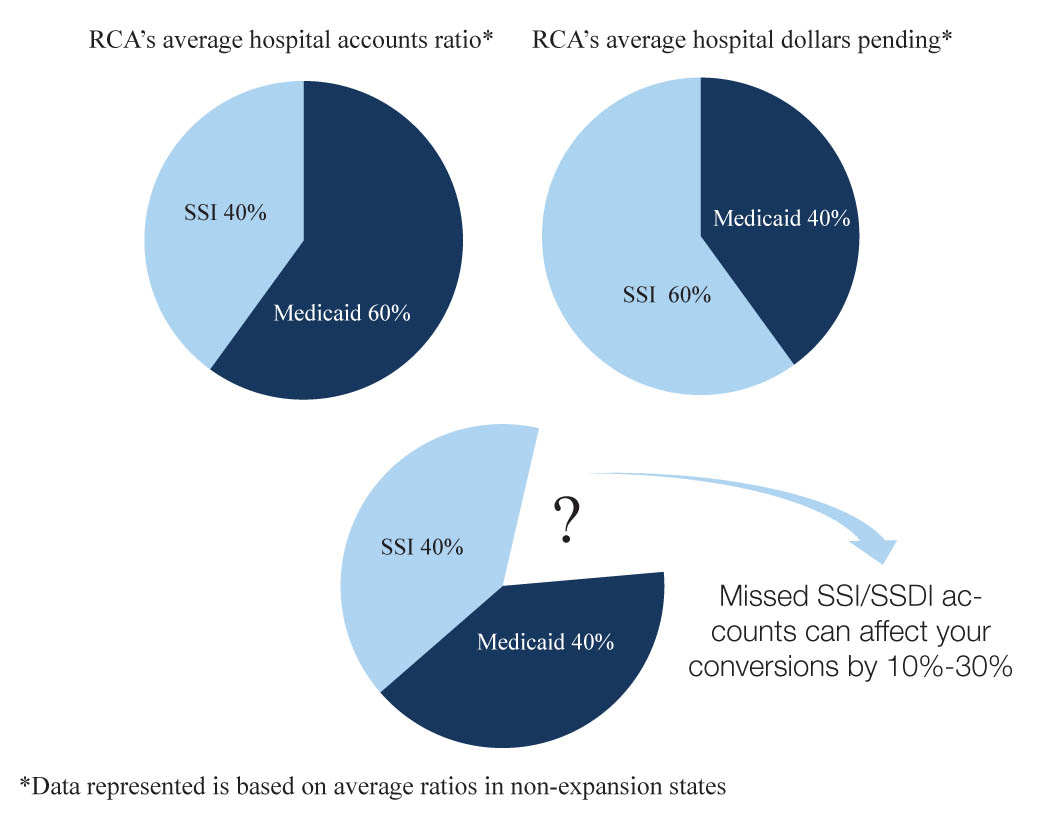
ssi-charts

Our S.O.A.R. (SSI/SSDI Outreach and Recovery) certified experts have over 22 years of experience handling SSI/SSDI claims. Through consulting and providing services to hundreds of providers in those two decades, we have seen that the following errors occur within the SSI process:

Not knowing where the patient is in the process – This seems silly, but it’s true. A lot of eligibility teams do not continue regular follow-up on SSI accounts. In some states, the SSI/SSDI process can take upwards of 2 years and this causes a misconception that accounts won’t progress for months at a time. However, there are many stages to the timely process and weekly or even biweekly follow-up can help hospitals know where the patient is in the process and also increase the approval odds by ensuring the Social Security Administration receives everything they have requested in a timely manner.

Returning referrals to the hospital due to outside representation – When a patient utilizes an attorney or other outside representation for help with their disability claim, it is often incorrectly assumed by the vendor that communication has been compromised and that they will not get the information they need to continue working the account. Returning those accounts negatively affects your bottom line because there are ways to help the representation and the Social Security office without compromising the patient’s relationship with their representative. Therefore our eligibility best practice rule #1 is to follow-up through reimbursement to the hospital.

Informational Claims (Dummy bills) aren’t being filed in time – Do you know your state’s Medicaid filing deadline? Some states have become savvy and will not pay SSI/SSDI cases if they never receive the bill or an application to protect the dates of service. Your team should be submitting timely claims in order to protect all dates of service for the patient and then rigorously following the account so the hospital can collect in the instance a patient is approved for Medicaid during the SSI/SSDI process. Accounts not filed in time or only sent through a batch filing software could be easily lost forever.

Stopping at mediocre – Often times our SSI/SSDI cases need a little extra attention. This means immediately filing appeals, providing patient transportation to doctors’ visits, regular physician follow-up and obtaining medical records. These value-added services reap big rewards when it comes to shortening A/R days.

bethany

Bethany Bailey
Vice President and Eligibility Expert

Safety-Net Medicaid Eligibility

canstockphoto4059461

By now, secondary eligibility has made a name for its self in the Hospital Revenue Cycle, but depending on your experience with this service there may be some mixed feelings about it. Typically, secondary Medicaid eligibility is used as a safety net behind primary vendors or in-house teams to maximize revenue recovery opportunities that may have been overlooked the first time. Some hospitals may choose a safety net vendor if they feel that their primary is under-performing or may opt out of this service if they feel that the eligibility team is surpassing conversion expectations. If your primary vendor is a lot to manage already, the thought of adding another vendor may seem cumbersome or you may fear it will cause interruption. The truth is that these assumptions are inaccurate for the most part, and there are several other factors to consider when determining if your hospital would benefit from a safety net service.

Safety net services are done completely behind the scene, are noninvasive to current processes and a contingency-based pricing schedule makes the recovery service risk-free. Because secondary cases are usually more difficult or are approaching deadlines, successful secondary vendors work referrals as thoroughly and rigorously as they would if they were the primary.

Do you feel like your Medicaid conversions should be higher? Has your third-party vendor become complacent on high or low dollar accounts? Are monthly reports leaving you uncertain about the data being received? A secondary vendor can ease those pains points by providing a closer look and offering expert advice.

If your hospital facility has more than 150 beds or a self-pay population of more than 10%, we strongly recommend a secondary eligibility vendor, regardless of the primary vendor’s performance. We have seen first-hand that adding some friendly competition to run eligibility behind the existing process can dramatically increase performance from all parties.bethany

Bethany Bailey
Vice President and Eligibility Expert

Follow-up is key to effective Medicaid reimbursements

hourglass

For best results and timely reimbursements, follow-up needs to be rigorous and consistent. RCA has heard from multiple clients that their eligibility vendors failed to stay on top of accounts and the money eventually ran away from them. Noncompliance and difficult patients are pain points that are made easier through constant contact and account monitoring.

From the minute your uninsured patient leaves the hospital, the clock begins ticking and that revenue becomes harder to recover. In many cases, patients are hard to reach by phone, do not respond to mail correspondence and even the most thoroughly trained staff will struggle with gathering the much needed documentation for maximum reimbursement.

We’ve found that weekly communication to the case worker, agencies and the patient is critical to shortening the amount of A/R days to payment. In search of discharged patients, sometimes this consists of measures including home, jail and shelter visits, transportation to and from appointments, translations services and skip traces.bethany

Bethany Bailey

Vice President of Operations

Losing self-pay dollars?

Losing self-pay dollars is not a fight you should walk away from. Whether your facility manages eligibility in-house or has partnered with a vendor, there are still parts that need monitoring to make sure you and your patients come out the winners.

We have been asked to perform hundreds of eligibility audits to determine if money is being left on the table; below are the biggest pain points we evaluate during a standard review.

canstockwebPromptness of Inpatient screening – It is easy to assume the patient is being screened for government assistance before they leave the facility, but unfortunately that is not always the case. This is the first place our experts evaluate. To make a quick determination and build a relationship with the patient, your eligibility team needs to be doing screenings within 24 hours of admission.

Follow-up on account progression – It is very important to monitor self-pay accounts regularly. If we don’t see regular notes made in the hospital system regarding account progression, it’s a red flag that the current process may be hurting the bottom line.

Payment follow-up – Your eligibility vendor or in-house team needs to make payment follow-up a priority in the recovery process. We find billing and payment to be an easily missed task and a costly point in the revenue cycle. A successful eligibility process does not end with follow-up. The most important piece is ensuring the hospital receives payment.

Depending on the patient mix, self-pay numbers can range making it hard to determine exactly how much a hospital’s recovery should be. Typically, we’ve seen anywhere from 20-30% of self-pay populations qualify for assistance in non-expansion states and conversions rates on net placements between 91-96%. We suggest you take a closer look at the above-mentioned points of your eligibility process if your numbers seem lower than our expert advice.

bethany

Bethany Bailey
Vice President and Eligibility Expert